
Loot, vending and NPC profiles
One panel, three systems: what a crate or barrel contains, what a vending machine sells and for what, and which NPCs spawn around a set of points. Open it with TOOLS > Profiles (Loot, Vending, NPC)… and pick the LOOT, VENDING or NPC SPAWNERS tab.
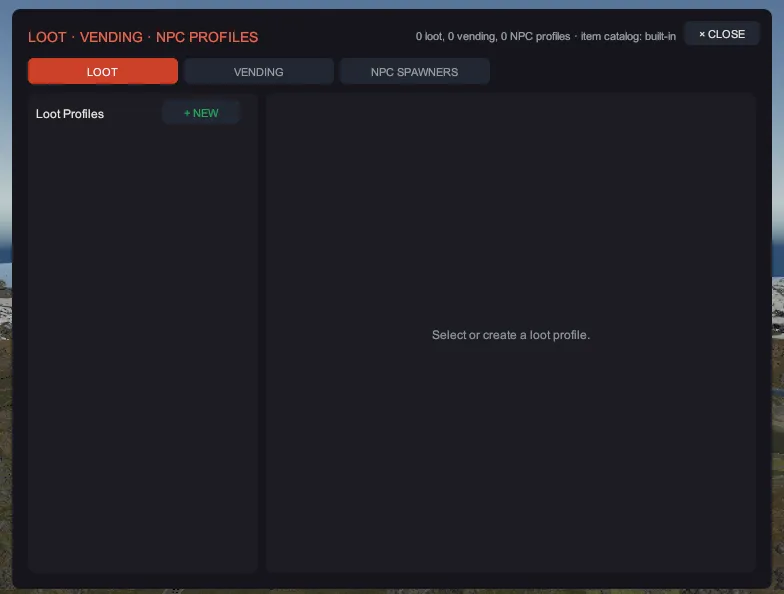
A profile is a recipe, and a placement is what attaches it to one object on the map. That split is the whole idea of the panel: you write “military crate, three to five rolls, these items at these weights” once, then attach it to as many crates as you like. Nothing you author here is a prefab, so nothing is visible in the viewport.
- Click + NEW in the Loot Profiles column. You get a uniquely named profile.
- Set Name, then Min rolls and Max rolls: how many item stacks the container spawns.
- Turn on Clear existing loot if the profile should replace the container’s own table rather than add to it.
- Click + ITEM under Items and search for the item. The picker searches the game’s items.
- On each item row set
min,maxandwt: the smallest and largest stack, and the relative weight that decides how often this item is the one picked. - Select the container in the viewport, then click + ATTACH under Placements (attach to selected container). If nothing is selected the panel says Select a container/machine in the scene first.
Every edit is one undo step. The × chip on a row removes it.
Vending
Section titled “Vending”The shape is the same, with sell orders instead of items:
- Click + NEW in the Vending Profiles column.
- Set Name (the profile’s own name) and Shop name (what players see on the machine).
- Broadcast to map is on for a new profile, so the shop announces itself; turn it off to keep the shop off the map. Either way it is kept when the map is saved and opened again.
- Click + ORDER under Sell orders and pick the item being sold.
- On the order row set what is sold and how many, what it costs and how many of that, and
stk, the number the machine holds in stock. A new order starts at 10. A stock of 0 is kept as 0, so the machine shows the order with none to sell. - Select the machine in the viewport and click + ATTACH.
Both sell and cost are pickers, so you can change either side of an order later without deleting
it.
NPC spawners
Section titled “NPC spawners”- Click + NEW in the Spawn Groups column.
- Set Name, Population max, Respawn min (s), Respawn max (s), and Initial spawn if the group should be full the moment the map boots.
- Click + PREFAB under NPC prefabs (from bundles) and pick the NPC. The list follows your Rust content, so NPCs Rust adds appear once Rust has updated.
- Set
wton each prefab row to weight which of them a spawn picks. - Add the points the NPCs stand on: + AT CAMERA drops one where you are looking, or use the Spawn Points tool to click and drag them out on the terrain.
The group’s name is the link: a spawn point stores the name of its group, so renaming a group after
its points exist leaves them pointing at a group that is not there. The
Spawn Points panel marks those points (missing: name) in red,
which is the quickest way to find them after a rename.
What the server does with all this
Section titled “What the server does with all this”All three are saved in your .map. Applying them
needs the server extension: see Run your map on a server.
Without it, the crates hold their normal loot, the machines sell their normal stock and no NPC spawns.
With it, at map load:
| System | What is applied |
|---|---|
| Loot | The matched container is filled from your profile every time the game fills it: cleared if you asked, then it picks between Min rolls and Max rolls stacks by weight. |
| Vending | The matched machine’s sell orders, shop name and broadcast flag are rebuilt from your profile, and a vending machine restocks them. |
| NPC spawners | Each group becomes a real spawn group with your population and respawn numbers, its points are wired to it with their facings, and Initial spawn fills it immediately. |
A loot profile stays with its container. Rust refills crates and barrels by itself, and brings back a crate that was emptied. The extension rolls your profile again each time, so the container never falls back to its normal loot, and a crate a player has half emptied is left as it is when the server restarts. This applies to crates, barrels and the other containers that hold loot of their own; a plain storage box you attached a profile to is filled once, when the server starts. In Creator 0.1.8 and older the profile was applied once at server start and the normal loot returned at the first refill.
A vending machine restocks your orders. An order that is bought out comes back over time, up to the Stock you set. A machine shows at most seven orders at a time: give a profile more than seven and Rust picks seven of them each time it sets the machine up. A shop front that a shopkeeper stands behind, and a vending machine a player owns, keep the orders they get when the server starts, and their stock is not refilled. In Creator 0.1.8 and older that was true of every machine.
Shop fronts need a shopkeeper
Section titled “Shop fronts need a shopkeeper”Rust has two kinds of shop. A vending machine (npcvendingmachine in the prefab browser) works by itself. A
shop front (shopkeeper_vm_invis, and the water well’s shopkeeper_vm_invis_waterwell) is the invisible
counter a shopkeeper stands behind, and nobody can buy from it until a shopkeeper stands within one meter of
it. That is why Rust’s own monuments place the two at the same spot.
Select a shop front and the inspector’s Shopkeeper section says whether one stands at it. If none does, ADD SHOPKEEPER places the right one (the bandit shopkeeper, or the water well’s for a water well shop front) at the shop front’s own position and rotation, as one undo step. It is an ordinary prefab from then on: you can see it, move it and delete it.
Two notes from the server-ready check go with this:
| Note | What it means |
|---|---|
| A shop front has no shopkeeper within a meter | Nobody can buy from it. Add one, or let the server extension add it (below). |
| A shop front has its shopkeeper beside it | The pair may not work in game without the extension. With the server extension it always works; without it, check each shop in game. |
The extension can also add a missing shopkeeper by itself. That is off unless the map asks for it: set Shopkeepers to Add when missing under FILE > Map Settings > Server upkeep.
Creator refuses to save a set that a server could not make sense of, with Save blocked. and the reason: two profiles sharing a name, a profile with no name, or a placement or point that references a profile or group that does not exist. Fix what the message names and save again.